Tuesday, March 28, 2006

Solar Eclipse on Wednesday 29th March!

On March 29, 2006, a total solar eclipse will occur when the new moon moves directly between the sun and the earth. The moon’s shadow will fall on the eastern tip of Brazil, speed eastward across the Atlantic, through northern Africa, across the Mediterranean. We will link with The British School of Lome in Togo, West Africa to receive and analyse data they collect on temperature, humidity and light level.

More detailed maps and information of exactly where the shadow will pass can be found on this link and this Nasa site has fantastic multimedia presentations about eclipses.

The IB Physics group at the British School of Lome will be more than welcome to pass on any comments about their experience on eclipse day. They will experience approximately 3.45s of totality, If you have specific questions you want answered you may email Mr Jackson before 06:45 GMT on Wednesday when I can take the questions to the students. At 07:00 we leave for the event. Thailand in on GMT +6.

To see a total solar eclipse, you have to be in exactly the right place at exactly the right time—inside the moon’s shadow as the earth, moon, and sun align.

The second map shows the paths of totality of upcoming total eclipses. To see one in person during the next few years, you may have to do some travelling! The school on Lome will be able to observe the eclipse at 9.15GMT. Watch this space!

Sunday, March 26, 2006

The Best Matchstick Trick Ever

What you need:

A matchstick. A cocktail stick will also work, if you fancy a break with tradition
A 10 baht coin
A glass, not much wider than the matchstick (or cocktail stick) is long
A balloon (or a plastic pen, ruler or comb)

What you do:

Stand the coin on its edge, on a handy table.
You need to balance the matchstick (or cocktail stick) on the coin. That could take you a while.
Once you've got everything balanced, turn the glass upside-down and cover the coin and stick with it.
Your challenge now is to get the stick off the coin, without knocking the coin over. You're not allowed to bash the table, touch the glass, or bounce up and down on the floor. (I've slightly given the game away by saying that you need a balloon.)
Blow the balloon up and rub it on your hair/jumper/cat. Now, very carefully, bring the charged side of the balloon up towards the glass. You should see the matchstick start to twitch, and with a deft flick you can tip it off the coin. Alternatively you could use the plastic pen, ruler or comb (but they are not as good as the balloon).

What's going on:

It's another static electricity trick, of course. Rubbing the balloon rubs negatively-charged electrons onto it, so it attracts anything that's positively charged or (more likely) neutral. That includes the glass, coin and matchstick. But the force involved is very small, and only the match is light enough to move.

If you do the trick very slowly, and move the balloon back and forth a little, you should be able to turn the matchstick and control it a little. It looks spookily like there's a length of thread between it and the balloon, but of course there isn't. And you can't be blowing, either - the glass prevents that.

Friday, March 24, 2006

Welcome to the crazy world of animals

This weekend surely has an animal theme. Click here to see how many of these weird and wonderful animals you can identify (thanks to Mrs Moakes). There is a funny animals video on this link and I hear Mr Howes (our Patana swim coach) is thinking of using this Australian technique to improve our “tiger prawns” speed in the pool. Enjoy!
Tuesday, March 21, 2006

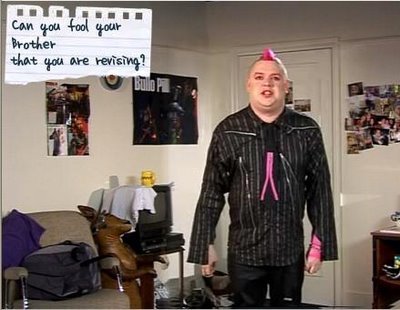
How many people can you fool into thinking you are revising?

Is this your brother? How many people can you fool into thinking you are revising for your science exam? Click the image left to test yourself (flash player needed - turn your speakers on!!) If you also want to practise some paper 1 multiple choice questions then click here and follow the instructions carefully.

Monday, March 20, 2006

Some Good Revision Tips

Andy Darvill says: "This advice is based on my experience of helping students through all kinds of exams. The ideas work for most people, most of the time - but if I've learned anything from life, it's that everybody is different, and that you need to figure out what works for you."
Go to his site on this link to look at top revision tips and use the site to revise. Here are a few others you could try:

BBC Bitesize Revision
Homeworkhigh.com
GCSE Answers
s-cool.co.uk
kent.skoool.co.uk

Saturday, March 18, 2006

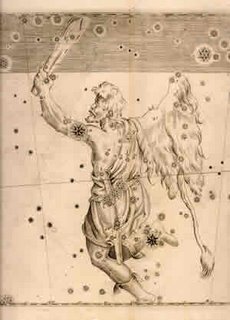
Search for Orion

The ancient Greeks saw the figure of the Greek myth Orion in the night-time sky. There are several different stories about the birth of Orion. According to one version of the myth, Orion was the son of a poor shepherd called Hyrieus. Once, Zeus, Hermes, and Poseidon stopped by Hyrieus' house. Hyrieus was so generous with his guests that he killed the only animal he had - an ox.

Hyrieus was not aware that his guests were gods. The gods wanted to reward Hyrieus' generosity by granting him a wish. Hyrieus' biggest desire was to have a child. The gods told him to bury the hide of the bull he had sacrificed to them and to pee on it. After nine months, a boy was born in that place. The child became a very handsome and strong man.

He was such a good hunter that he was hired by the king Oenopion to kill the ferocious beasts that were terrifying the habitants of the island Chios. Happy for his success, Orion said he would kill all the wild animals on the earth. But, the earth goddess Gaia, who was the mother of all animals, was not pleased with Orion's intention.

Then, Gaia set an enormous scorpion on Orion. Orion soon realized that his strength and sword were useless against that mighty beast. He tried to escape, but the scorpion stung him to death. As a reward, Gaia placed the scorpion in the sky as a constellation which appears to be constantly chasing after Orion whose figure was also placed among the stars.

Read more about Orion mythology at Windows to the Universe.

The image is courtesy of the United States Naval Observatory Library.

Friday, March 17, 2006

How do you perceive depth?


Depth perception can be upset when rules and knowledge are in conflict, as you can see in these short videos of well-known visual illusions. . This site offers full versions of many scientific papers by Richard Gregory FRS, Emeritus Professor of Neuropsychology at the University of Bristol, especially on perception and visual illusions. The videos are large and can be downloaded in QuickTime or RealVideo formats. If you do not have a suitable player installed on your computer, download one from the links on the page. Enjoy the weekend.