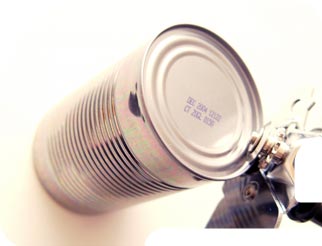
Monday, May 29, 2006

It's quiet. Too quiet. Time to change that.

What you need:

  • Lots of empty food cans. Look for the ones which have crimped lids at both ends. You'll need 4 or more cans per musical instrument.
  • A can opener. The kind that takes just the lid off, leaving the crimped rim.
  • Tape. Ordinary sticky tape will do, but best of all is electrician's insulation tape - you can stretch it a bit to make it really tight.

What to do:

NB Be very, very careful of sharp edges. Good can openers will leave a smooth edge, but even if you think you have one of those, take care when handling the can.

  1. Keep one can back - we'll come back to it in a moment.
  2. Wash the cans out, and remove both ends from them. If they go all floppy at this point, you have the wrong sort of can opener. Or the wrong sort of can. Or both.
  3. Join the cans end-to-end, and tape them very tightly, so you're making a single, rigid cylinder. A cylinder three cans long is enough, but four, five or six cans will work too. Go back to the can you held back, and add it to the end of your cylinder so you have a tube, closed at just one end. It may not look like much, but you've just made a musical instrument.
  4. Hold it lightly, and bash the closed end on the ground - you should hear the cylinder ring with a surprisingly pleasant note. I usually find it works best on carpet, and if you tilt the tube slightly so you're bashing the rim at an angle rather than the end, flat-on. If you make a number of cylinders of different lengths you'll find they play different notes - so you can drum away to your heart's content.

What's going on:

When you bash the tube, you start it ringing with a wide range of frequencies, but very quickly one note dominates - the natural frequency of the cylinder. The longer the cylinder, the lower the natural frequency - the lower the note.

My assumption is that the main wavelength produced is a little over twice the length of the tube, but without investigating with a spectrum analyser it's hard to know - let me know if you try. More mysterious is why the sound produced is so pleasant, when you'd expect a ghastly metallic clank. But then, musical instruments - even ones made out of old soup tins - are more an art than a science.

Incidentally, you need the double-rimmed cans because the other kind are too floppy when you take the base off. Many very cheap cans are stamped out of a single piece of aluminium with a lid added - they have rounded bases that are musically useless.

Find more practicals you can do at home on the practical of the week link below.

Drinking Straws and Pop!

This is one of those cool physical tricks that's difficult the first time, but extremely satisfying when you get it right, and extremely annoying for everyone else.

What you do:

You have to do all of the following quickly, as one sequence of events, so it's imperative that you and your accomplice have worked out how you're going to achieve it. Alternatively, you can be bumbling idiots so long as you have enough straws to practice with. Your choice.
  1. Hold the straw sideways in front of you, then fold over the ends - just a centimetre of them. Pinch the folds very tightly between your thumbs and forefingers.
  2. Now wind the straw up. The action is rather like twiddling your thumbs, only with a straw in the way. You'll find that the ends of the straw wind in towards the middle, which looks increasingly like it's bulging with all the air being squeezed into it. Uncanny, that, since it's bulging with all the air being squeezed into it.
  3. Your accomplice comes into play when you have about three centimetres of straw left, bulging away between the wound-up ends. Stop winding,and - quick, quick! - get your accomplice to flick that bit with their finger. They should flick hard, but should aim for the straw and not your knuckles. Especially after they've tried that gag the previous dozen times.
  4. If everything goes to plan, you should hear a sharp and very loud 'crack!'

What's going on:

Folding over the ends of the straw very nearly seals them, so when you wind the straw up you squeeze a straw's-worth of air into just that middle part. The pressure in there is very high - if you allow for a little air to leak out, it's still perhaps twice normal atmospheric pressure. You have to finish the trick quickly or the air will find its way out of the ends, which won't be perfectly sealed however tightly you're squeezing.

The flimsy straw can handle the pressure - but only barely, and only because a smooth cylinder is the best shape of pressure vessel there is. Flicking the straw distorts its cylindrical shape, increasing the stress at the sides. The result is that the plastic bursts, and you'll probably see a long slit up the side of the straw.

The loud noise you hear is the compressed air escaping rapidly through the slit.

If you're particularly dextrous and practice a bit, you might be able to flick the straw all on your own, without needing an accomplice at all. It's hard, though - click here to see a video of it being done (2MB .mov file - requires quicktime to play).

Sunday, May 28, 2006

Drinking Straws and Pop!

This is one of those cool physical tricks that's difficult the first time, but extremely satisfying when you get it right, and extremely annoying for everyone else.

What you do:

You have to do all of the following quickly, as one sequence of events, so it's imperative that you and your accomplice have worked out how you're going to achieve it. Alternatively, you can be bumbling idiots so long as you have enough straws to practice with. Your choice.
  1. Hold the straw sideways in front of you, then fold over the ends - just a centimetre of them. Pinch the folds very tightly between your thumbs and forefingers.
  2. Now wind the straw up. The action is rather like twiddling your thumbs, only with a straw in the way. You'll find that the ends of the straw wind in towards the middle, which looks increasingly like it's bulging with all the air being squeezed into it. Uncanny, that, since it's bulging with all the air being squeezed into it.
  3. Your accomplice comes into play when you have about three centimetres of straw left, bulging away between the wound-up ends. Stop winding,and - quick, quick! - get your accomplice to flick that bit with their finger. They should flick hard, but should aim for the straw and not your knuckles. Especially after they've tried that gag the previous dozen times.
  4. If everything goes to plan, you should hear a sharp and very loud 'crack!'

What's going on:

Folding over the ends of the straw very nearly seals them, so when you wind the straw up you squeeze a straw's-worth of air into just that middle part. The pressure in there is very high - if you allow for a little air to leak out, it's still perhaps twice normal atmospheric pressure. You have to finish the trick quickly or the air will find its way out of the ends, which won't be perfectly sealed however tightly you're squeezing.

The flimsy straw can handle the pressure - but only barely, and only because a smooth cylinder is the best shape of pressure vessel there is. Flicking the straw distorts its cylindrical shape, increasing the stress at the sides. The result is that the plastic bursts, and you'll probably see a long slit up the side of the straw.

The loud noise you hear is the compressed air escaping rapidly through the slit.

If you're particularly dextrous and practice a bit, you might be able to flick the straw all on your own, without needing an accomplice at all. It's hard, though - click here to see a video of it being done (2MB .mov file - requires quicktime to play).

Thursday, May 25, 2006

Science in Key Stage 3 (year 7,8 & 9)

Sometimes a google search just gives you too many places to look. Why not let the cyber monkey do all the hard work for you? He hangs around in cyberspace looking for the best science websites linked to the things you are learning in your science lessons. Take some time to have a look, especially useful if you don't fully understand something, want to do some research for your homework or learn something new. Look out for the odd banana thrown in - click them and see where they take you! Nearly forgot - click the monkey to go to find out more......

Saturday, May 20, 2006

It's quiet. Too quiet. Time to change that.

What you need:

  • Lots of empty food cans. Look for the ones which have crimped lids at both ends. You'll need 4 or more cans per musical instrument.
  • A can opener. The kind that takes just the lid off, leaving the crimped rim.
  • Tape. Ordinary sticky tape will do, but best of all is electrician's insulation tape - you can stretch it a bit to make it really tight.

What to do:

NB Be very, very careful of sharp edges. Good can openers will leave a smooth edge, but even if you think you have one of those, take care when handling the can.

  1. Keep one can back - we'll come back to it in a moment.
  2. Wash the cans out, and remove both ends from them. If they go all floppy at this point, you have the wrong sort of can opener. Or the wrong sort of can. Or both.
  3. Join the cans end-to-end, and tape them very tightly, so you're making a single, rigid cylinder. A cylinder three cans long is enough, but four, five or six cans will work too. Go back to the can you held back, and add it to the end of your cylinder so you have a tube, closed at just one end. It may not look like much, but you've just made a musical instrument.
  4. Hold it lightly, and bash the closed end on the ground - you should hear the cylinder ring with a surprisingly pleasant note. I usually find it works best on carpet, and if you tilt the tube slightly so you're bashing the rim at an angle rather than the end, flat-on. If you make a number of cylinders of different lengths you'll find they play different notes - so you can drum away to your heart's content.

What's going on:

When you bash the tube, you start it ringing with a wide range of frequencies, but very quickly one note dominates - the natural frequency of the cylinder. The longer the cylinder, the lower the natural frequency - the lower the note.

My assumption is that the main wavelength produced is a little over twice the length of the tube, but without investigating with a spectrum analyser it's hard to know - let me know if you try. More mysterious is why the sound produced is so pleasant, when you'd expect a ghastly metallic clank. But then, musical instruments - even ones made out of old soup tins - are more an art than a science.

Incidentally, you need the double-rimmed cans because the other kind are too floppy when you take the base off. Many very cheap cans are stamped out of a single piece of aluminium with a lid added - they have rounded bases that are musically useless.

Find more practicals you can do at home on the practical of the week link below.

Saturday, May 13, 2006

What's Dolphin for 'Flipper'?

Dolphins have the ability to call each other by name - just like humans! Scientists have found the mammals recognise themselves and other members of their species with special whistles. Up until now, humans were thought to be the only species that actually use names for one another.

Scientists say it's not unusual for animals to use sounds recognised by whole species, but it is extremely rare for species to use individual 'names' to communicate.

During the study experts caught a group of wild dolphins and recorded their calls. Scientists used a computer to copy the calls and then played them back to the dolphins. Most of the dolphins responded to the whistles of their relatives, suggesting they can recognise each other's signature whistle.

And if you thought this was uncannily human - what about pig makeovers?

Wilma, a Vietnamese pot-bellied pig, was rejected by two potential boyfriends so her keepers at Twin Lakes Park decided to give her a hand. The lonely sow has been given a bath and a trotter manicure to make her feel good. Wilma also had a special pig massage and her sty has been tidied. It's hoped the treats will do the trick and encourage Wilma to start a family.

Keeper Sue Statham said she hoped the makeover would boost Wilma's confidence: "We think Wilma is a very beautiful pot-bellied pig but she has been most unsuccessful in love. We are really hoping that by making her feel good about herself, she'll entice the boys into her sty."

Whatever next? Hamster spas? Hot tubs for depressed Koi carp?

More on this link.......

A very cool evolutionary game

click here to startrEvolution is the online biology experience from Cambridge University. To get started, click on the image left! (Flash version 8.0 required)